
My passion lies in exploring the intersection of technology and philosophy, specifically how technological advancements shape human society and culture. A historical example of this is the invention of the compass, which revolutionized navigation and trade during the Renaissance, sparking global exploration and intellectual growth. Similarly, today’s technologies, such as AI, are reshaping the world of work, presenting both challenges and opportunities for society.
As CTO at Portland Trust, I often reflect on how AI and automation are transforming industries and the workforce. The rise of these technologies prompts us to reconsider the nature of work and social structures, urging society to adapt and prepare for a future where automation and AI play a pivotal role. The question we face is how to balance progress with equity in this rapidly changing landscape.
The Future of Work: Navigating Through Automation, AI, and Equity
The concept of “work” has evolved significantly over time, shaped by social, economic, and technological changes. A historical exploration of this topic reveals an interesting connection to the utopian visions of the past, particularly those espoused by thinkers like Thomas More. In his seminal work Utopia (1516), More described an ideal society where work was distributed equally and every citizen had access to basic needs. His vision, while far from being a reality in the modern world, continues to inspire discussions around the future of labor, social equity, and the role of technology in shaping societies.
In the 21st century, the world of work is rapidly evolving. Driven by AI and automation technologies, industries globally are being disrupted. These changes demand immediate action and forward-thinking to safeguard society’s well-being. The possibility of a “post-work” society, as envisioned by thinkers like André Gorz, comes into sharper focus. Gorz, a social philosopher, predicted a world where technology would lessen the human burden of labor, allowing individuals more time for personal development and social engagement, rather than being bound by the need to work for survival.
The Rise of AI and Automation: Transforming the Workplace
AI and automation are transforming industries at a rapid pace, automating tasks that once required human input—ranging from customer service and logistics to complex data analysis and manufacturing. Machines are now performing tasks more efficiently and accurately than ever before. Examples include automated warehouses, self-driving vehicles, and AI-powered software capable of drafting legal contracts, diagnosing diseases, and even generating artistic content.
While this technological progress is exciting, it also raises a crucial question: What happens to jobs when machines surpass human capabilities? According to a McKinsey report, between 400 million to 800 million jobs globally could be displaced by automation by 2030. Although certain sectors are expected to experience growth, many jobs that rely on repetitive manual or cognitive tasks may become obsolete, leaving workers vulnerable to displacement.
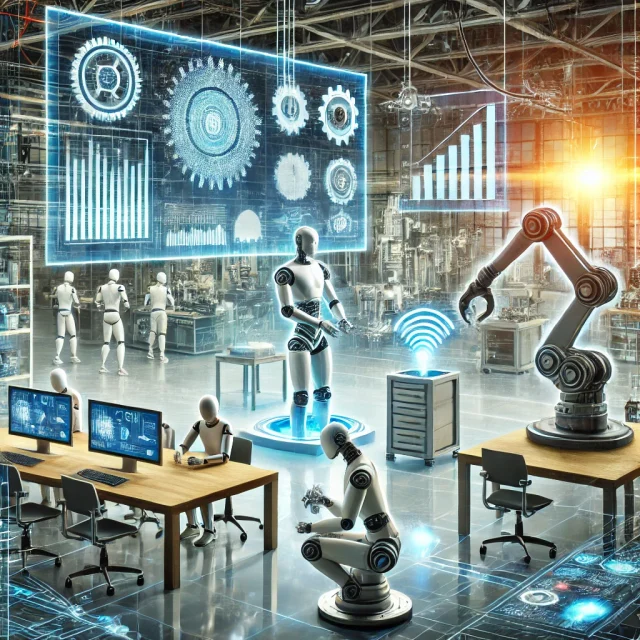
Robots and AI at work
The Reduction of Human Labor: Where Does That Leave Us?
With automation taking over many jobs, a world where people work fewer hours—or not at all—seems more feasible than ever. This prompts a shift in focus from merely working to survive, to working as a means of personal fulfillment or creative expression. The potential reduction of labor presents an opportunity to rethink the purpose of work in society. However, to truly build a sustainable future for society, we must not only mitigate the challenges presented by AI and automation but also proactively redefine the very nature of work itself.
The displacement of millions of workers could lead to significant social unrest, inequality, and a further concentration of wealth. To mitigate these consequences, we must plan for a future that ensures the well-being of all, not just those who thrive in the new economy.
Universal Basic Income (UBI): A Solution to Inequity?
One potential solution is Universal Basic Income (UBI). UBI is a system in which all citizens receive a fixed income, regardless of employment status, to ensure a basic standard of living. The idea of UBI is gaining traction in the context of AI-driven job displacement. By decoupling income from work, UBI could provide financial security to those whose jobs are replaced by automation while also encouraging innovation and entrepreneurship.
Countries such as Finland and Canada have already experimented with UBI pilots, with positive results in reducing poverty and increasing overall well-being. While not without its critics, UBI presents a possible framework for managing the societal impact of reduced labor. It provides a safety net for those transitioning between jobs or learning new skills and allows for greater social equity in a world where not everyone may be needed in the workforce.
Lifelong Learning and Adaptation: Preparing for the Future
In addition to UBI, there must be a fundamental shift in how we approach education and skill development. Lifelong learning and adaptation will be critical for workers of all sectors as jobs evolve alongside rapid technological advancements. Individuals need to develop the mindset and skills to evolve with these changes.
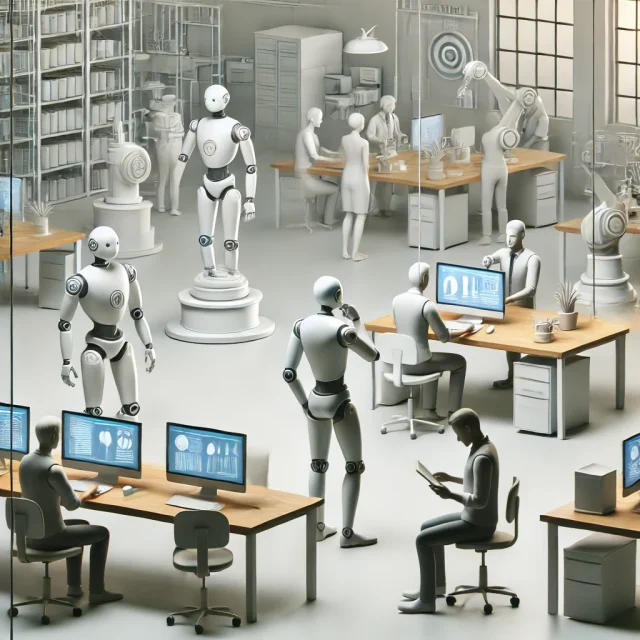
Robots and AI in office environment
The Role of Regulation: Preventing a Dystopian Society
Despite the potential benefits of automation and UBI, we must remain cautious of the risks. Without proper regulation, the future of work could lead to a highly unequal and dystopian society, where a few corporations control vast amounts of wealth and power while the majority struggle to survive. To prevent such an outcome, governments and international bodies will need to implement comprehensive regulations.
Firstly, regulations around the deployment of AI and automation are crucial. This includes ensuring ethical AI development, preventing the monopolization of AI technologies, and protecting workers’ rights during the transition. Additionally, laws must address data privacy, cybersecurity, and the potential misuse of AI for surveillance or discrimination.
Furthermore, tax reforms may be necessary to ensure that wealth generated by AI and automation is fairly distributed. Corporations that benefit from reduced labor costs should contribute to the social safety net that supports displaced workers. Moreover, UBI must be coupled with investments in education and re-skilling programs to help individuals transition into new roles in the AI-driven economy.
Building a Fairer Future: Balancing Progress and Equity
Clearly, the future of work is being shaped by the rapid development of AI and automation, which have the potential to improve productivity and create new opportunities. However, if left unchecked, these advancements could lead to greater inequality and societal unrest. To navigate this transition successfully, we must adopt solutions like UBI, invest in education, and implement forward-thinking regulations to ensure a fair and just society.
In this new world, work may no longer be a necessity for survival but rather an opportunity for personal growth and fulfillment. By preparing for these changes today, we can ensure that the future of work benefits everyone, rather than a select few. Thomas More’s vision of a more equitable society may not be as far-fetched as it once seemed, but realizing it will require proactive steps to address the challenges of AI, automation, and inequality.
The choices we make today are critical, and every stakeholder—individuals, corporations, and governments—has a role to play in shaping a future where prosperity is shared, and technological progress benefits all. By taking responsibility and acting decisively, we can avoid a divided society and create a world where human potential is fully realized.


